Chapter 2
The Payment Journey
Understanding What Happens After a Payment Begins
Every payment starts with a simple intention.
A customer wants to buy something. A merchant wants to complete a sale. Between those two points, a payment platform must transform an intention into a trusted, authorized, financially traceable transaction.
From the outside, this journey appears almost instantaneous. A card is tapped, a QR Code is scanned or a payment link is confirmed. Seconds later, the customer sees an approval message and the merchant receives confirmation that the sale can proceed.
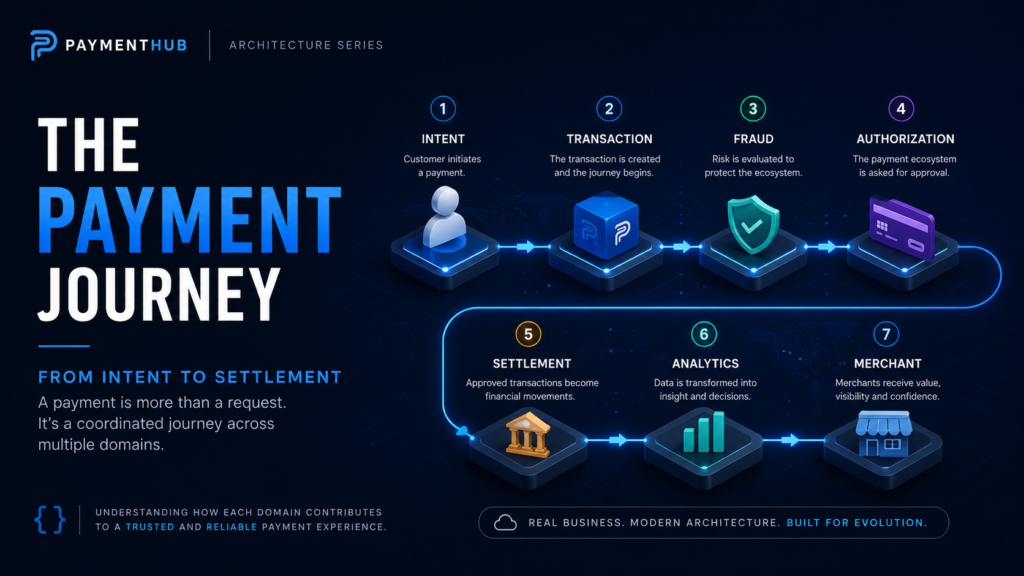
Inside the platform, however, that simple experience is the result of multiple business capabilities working together. Each capability answers a different question, owns a different responsibility and contributes to a specific part of the payment lifecycle.
This chapter follows the journey of a payment through PaymentHub. The goal is not to explain every internal detail of each domain, but to understand how the platform behaves as a complete ecosystem.
Before looking deeply into Transaction, Fraud, Authorization, Settlement, Merchant and Analytics, it is important to understand the journey they collectively support.
The Journey Starts Before the Transaction
A payment does not truly begin when a transaction reaches the platform.
It begins earlier, with the merchant.
Before any payment can be processed, the platform needs to understand who the merchant is, which products are enabled, which settlement rules apply, which risk profile is associated with the business and how that merchant should interact with the payment ecosystem.
This is why the Merchant Domain is so important.
Although the operational journey usually becomes visible when a transaction is created, the commercial relationship already exists before that moment. The merchant profile provides context for everything that follows.
A transaction without merchant context is just a technical request.
A transaction with merchant context becomes part of a business relationship.
This distinction matters because payment platforms are not built only to move information between systems. They exist to support businesses. Every authorization, fraud evaluation, settlement process and analytical report ultimately depends on a reliable understanding of the merchant behind the transaction.
Entering the Platform
Once a customer initiates a payment, the request enters the platform and becomes a transaction.
At this stage, the platform still does not know what the final outcome will be. The payment may be approved, declined, blocked by fraud rules, fail due to timeout or require additional processing depending on the business scenario.
What exists at this moment is uncertainty.
The role of the platform is to reduce that uncertainty step by step.
The Transaction Domain is responsible for giving structure to this journey. It receives the request, establishes a transaction identity, records the initial state and coordinates the interaction with the other domains.
This is an important architectural decision.
The Transaction Domain does not exist to make every decision by itself. It exists to ensure that the journey is controlled, traceable and consistent. It becomes the point from which the platform can understand where a transaction started, which steps were executed and which outcome was produced.
In payment systems, traceability is not optional. Without it, support teams cannot investigate issues, financial teams cannot reconcile values and engineering teams cannot understand failures.
A transaction needs a story.
The Transaction Domain is where that story begins to be recorded.
Trust Before Approval
After the transaction enters the platform, the next question is not whether the payment can be approved.
The first question is whether the platform can trust it.
This is the responsibility of the Fraud Domain.
Fraud prevention is one of the most delicate capabilities in a payment platform because it must protect the ecosystem without damaging the customer experience. A weak fraud strategy exposes merchants and financial institutions to losses. An overly aggressive strategy blocks legitimate customers and reduces conversion.
The best fraud systems are often invisible.
They work in the background, evaluating signals, identifying suspicious patterns and allowing legitimate transactions to continue without unnecessary friction.
In PaymentHub, the Fraud Domain represents this trust evaluation step. It analyzes the transaction from a risk perspective before the platform proceeds to authorization.
This separation is important because fraud and authorization answer different questions.
Fraud asks:
Can we trust this transaction?
Authorization asks:
Can this transaction be approved by the payment ecosystem?
These questions are related, but they are not the same. Treating them as separate responsibilities creates clearer boundaries and allows each capability to evolve independently.
The Authorization Decision
Once the transaction has been evaluated from a risk perspective, the journey reaches the Authorization Domain.
This is the moment most people associate with payment processing.
A request is sent to the external payment ecosystem. The platform waits for a response. The result eventually comes back as approved, declined or failed.
Although this appears simple at a high level, authorization is one of the most integration-heavy parts of a payment platform.
The platform may need to communicate with acquirers, issuers, card networks, gateways or other external providers. It may need to handle timeouts, retries, protocol differences, response mappings and operational failures.
The customer sees only a few seconds.
The platform sees an ecosystem.
The Authorization Domain exists to abstract that complexity from the rest of the platform. Its responsibility is not only to obtain a decision, but to make that decision usable, traceable and consistent within the internal payment journey.
A good authorization layer protects the internal architecture from external complexity.
It allows the platform to evolve its internal domains without exposing every part of the system to the details of payment networks, integration protocols or provider-specific behaviors.
Approval Is Not the End
One of the most common misunderstandings in payment systems is assuming that an approved transaction means money has already moved.
It has not.
Authorization and settlement are different stages of the payment lifecycle.
Authorization confirms that a payment can proceed. Settlement is the process through which financial obligations are prepared, reconciled and eventually moved toward the merchant.
This difference is fundamental.
From the customer’s perspective, the purchase may appear complete once approval is displayed. From the merchant’s perspective, however, the financial journey continues until the transaction is captured, reconciled and settled according to the applicable business rules.
The Settlement Domain owns this part of the lifecycle.
It represents the bridge between real-time transactional decisions and financial operations. It prepares the platform to answer questions such as:
- Which transactions should be settled?
- Which merchant should receive funds?
- Which fees apply?
- Which values need to be reconciled?
- Which financial records must be produced?
This is where payment architecture becomes deeply connected to financial integrity.
Processing a payment is not enough. The platform must also ensure that the financial consequences of that payment can be understood, audited and executed correctly.
Turning Operations Into Insight
After a payment has moved through the operational journey, a new journey begins.
The journey of data.
Every transaction produces information. Approved payments, declined attempts, fraud decisions, authorization responses, settlement events and merchant activity all become part of the platform’s analytical foundation.
This is where the Analytics Domain becomes relevant.
Analytics is not just about dashboards. It is about transforming operational events into business understanding.
A payment platform needs to answer questions such as:
- How much volume is being processed?
- Which merchants are growing?
- Where are declines increasing?
- Which fraud patterns are emerging?
- How effective is the authorization flow?
- Where are settlement issues occurring?
These questions cannot be answered by looking at a single transaction in isolation. They require the platform to aggregate, contextualize and interpret data across multiple domains.
The Analytics Domain closes the loop by transforming transaction history into decision support.
The platform does not only process payments.
It learns from them.
The Complete Journey
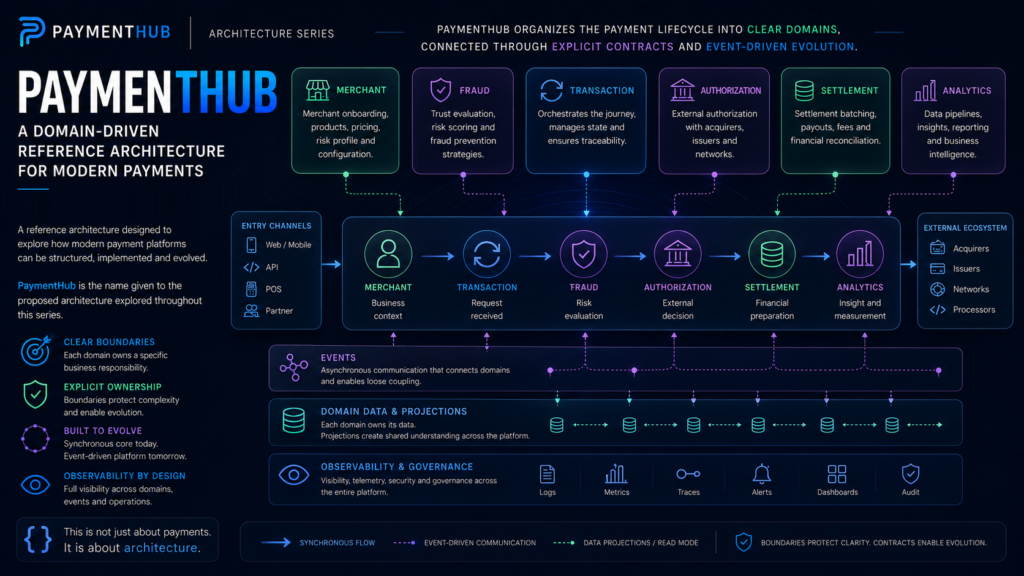
When viewed as a whole, the PaymentHub journey can be understood as a sequence of responsibilities.
Merchant Domain
provides the business context
Transaction Domain
coordinates the payment request
Fraud Domain
evaluates trust
Authorization Domain
obtains the external decision
Settlement Domain
prepares the financial outcome
Analytics Domain
transforms operational data into insight
Together, these domains create a platform that is more than a collection of services. They represent a structured way of organizing business capabilities around the payment lifecycle.
A simplified view of the journey looks like this:
Merchant
    ↓
Transaction
    ↓
Fraud
    ↓
Authorization
    ↓
Settlement
    ↓
Analytics
This flow is intentionally simple.
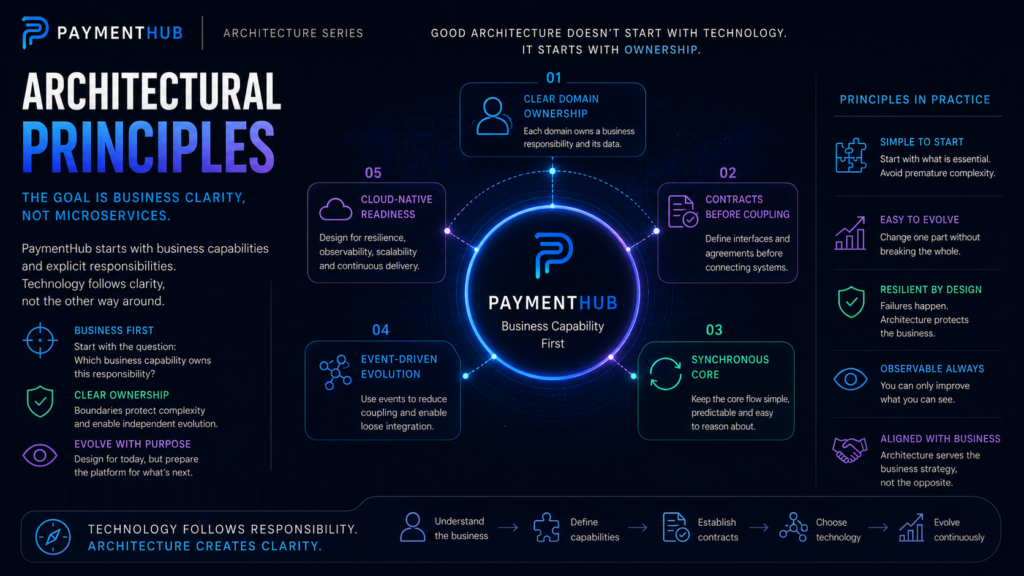
Its purpose is not to describe every possible scenario, exception or integration detail. Its purpose is to provide a mental model for understanding how responsibilities move across the platform.
As the architecture evolves, this journey may become more sophisticated. Events may replace some synchronous interactions. Additional domains may emerge. New payment methods may be introduced. More advanced risk, ledger or reconciliation capabilities may appear.
But the core principle remains the same.
A modern payment platform becomes easier to evolve when its responsibilities are clear.
Looking Ahead
This chapter introduced the payment journey as a connected sequence of business responsibilities.
The next chapters will explore each domain individually, starting with the Transaction Domain.
That is where the operational journey begins.
At the moment a transaction enters the platform, uncertainty is at its highest. No decision has been made, no risk has been evaluated and no financial outcome exists yet.
The Transaction Domain is responsible for turning that uncertainty into a controlled, traceable journey.
It does not approve.
It does not reject.
It does not settle.
It orchestrates.
And in a distributed payment platform, orchestration is where clarity begins.