Architectural Principles
Every architecture reflects a set of decisions.
Some decisions are explicit and documented. Others emerge naturally from experience, constraints and business priorities. Over time, those decisions become the foundation upon which the entire platform evolves.
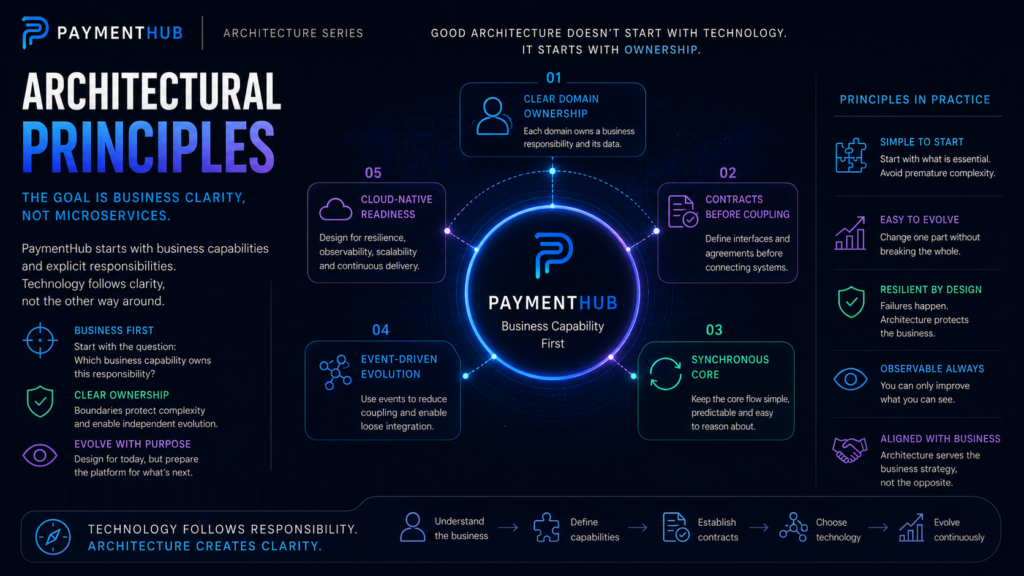
PaymentHub was not designed around a specific technology stack, cloud provider or architectural trend. It was designed around a set of principles intended to create clarity, support evolution and provide a realistic environment for studying modern platform architecture.
These principles influence every domain, integration and design decision throughout the project.
Domain-Driven Thinking
One of the most important decisions behind PaymentHub is the choice to organize the platform around business capabilities rather than technical layers.
In many traditional systems, architecture is structured around components such as databases, APIs, user interfaces or integration services. While these elements remain important, they rarely represent how the business itself thinks about its operations.
Payment platforms are fundamentally collections of business responsibilities.
Merchants need to be onboarded.
Authorizations need to be obtained.
Transactions need to be coordinated.
Fraud needs to be evaluated.
Funds need to be settled.
Data needs to be transformed into insight.
Each of these responsibilities evolves at a different pace, serves different stakeholders and introduces different technical requirements.
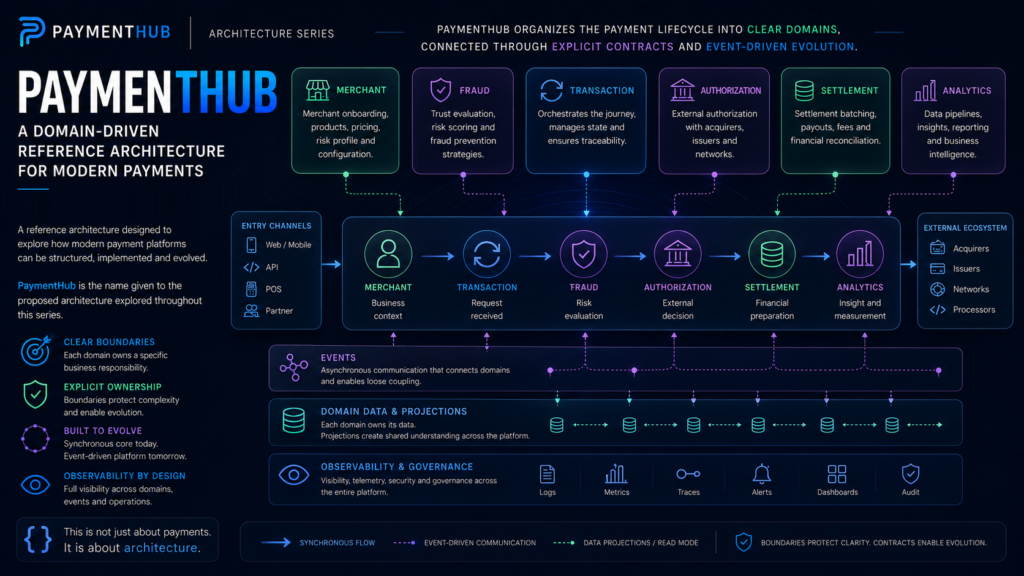
By treating them as independent domains, PaymentHub creates clear ownership boundaries and allows each capability to evolve without unnecessarily impacting the others.
The objective is not microservices.
The objective is business clarity.
Separation of Responsibilities
A recurring source of complexity in large systems is responsibility overlap.
When multiple components perform similar functions, ownership becomes unclear. When ownership becomes unclear, architectural decisions become harder to make and systems become increasingly difficult to evolve.
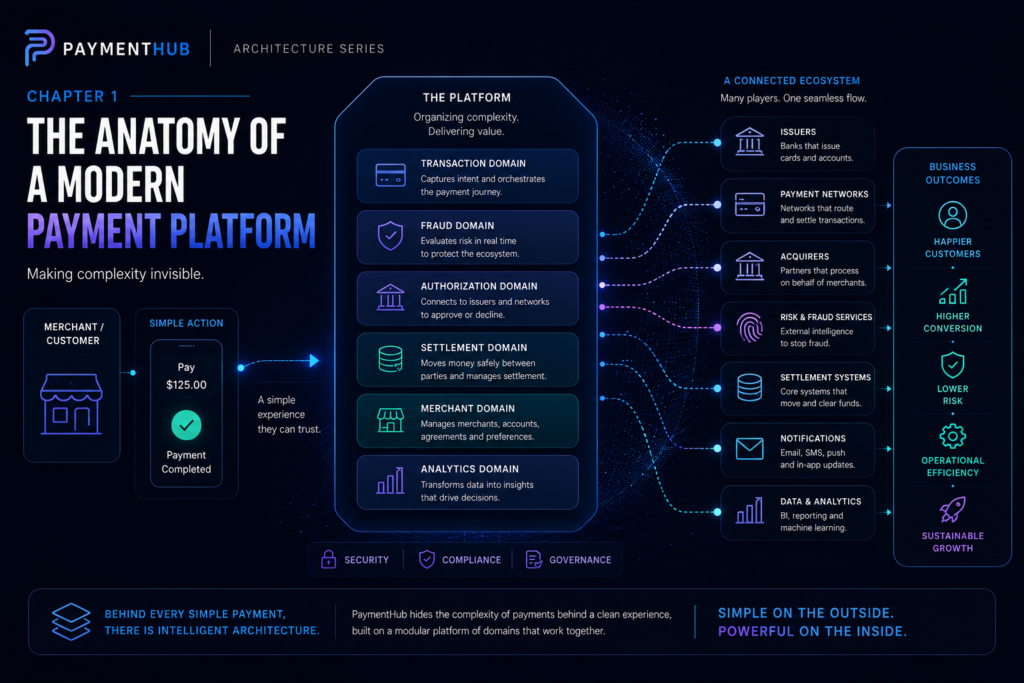
PaymentHub intentionally separates responsibilities into distinct domains.
The Transaction Domain orchestrates.
The Fraud Domain evaluates risk.
The Authorization Domain communicates with external payment ecosystems.
The Settlement Domain manages financial movements.
The Analytics Domain transforms operational data into business insight.
Each domain exists for a reason.
Just as importantly, each domain deliberately avoids responsibilities that belong elsewhere.
This separation reduces coupling, improves maintainability and creates a platform that is easier to understand for both technical and business stakeholders.
Evolution Over Perfection
One of the most common mistakes in software architecture is attempting to solve future problems before they exist.
Architects often face the temptation to design for infinite scale, extreme resilience and every possible future scenario from the very beginning. While the intention is usually positive, the result is frequently unnecessary complexity.
PaymentHub adopts a different philosophy.
The platform is intentionally designed to evolve.
Solutions are introduced when they become justified by business requirements, operational constraints or architectural learning objectives.
This principle influences decisions throughout the project.
Synchronous communication is preferred initially because it is easier to understand and debug.
Event-driven patterns are introduced later when they provide clear benefits.
Infrastructure remains intentionally simple until complexity becomes necessary.
The goal is not to build the most sophisticated architecture possible.
The goal is to build an architecture capable of becoming more sophisticated over time.
Event-Driven Readiness
Although the initial implementation of PaymentHub relies primarily on synchronous communication, the architecture was designed with future event-driven evolution in mind.
This distinction is important.
Being event-driven does not necessarily mean starting with events everywhere.
In many environments, introducing asynchronous communication too early creates unnecessary operational complexity.
Instead, PaymentHub focuses on establishing clear domain boundaries first.
Once responsibilities are well understood, events become a natural mechanism for communication and collaboration between domains.
Future iterations of the platform are expected to introduce capabilities such as:
By postponing this complexity until it becomes valuable, the architecture remains understandable while preserving a clear path toward scalability.
Cloud-Native by Design
PaymentHub was created as a platform intended to evolve into AWS-native environments.
This does not mean that every problem should be solved with a cloud service.
Instead, it means architectural decisions are evaluated with future cloud adoption in mind.
Services should scale independently.
Domains should remain deployable in isolation.
Infrastructure should support automation.
Operational visibility should be considered from the beginning.
This principle influences the selection of technologies, deployment models and future architectural roadmaps.
The objective is not cloud adoption for its own sake.
The objective is creating a platform that can benefit from cloud capabilities when the time is right.
Architecture as a Learning Platform
Perhaps the most important principle behind PaymentHub is that the project exists to support learning.
Every domain, integration and design decision serves two purposes.
The first is solving a realistic business problem.
The second is creating opportunities to explore architectural concepts in practice.
Questions such as:
- Should this capability be synchronous or asynchronous?
- Would an event improve this interaction?
- When should a service become independent?
- Is a relational model more appropriate than a key-value model?
- How should ownership boundaries evolve?
These questions are intentionally part of the journey.
PaymentHub is not simply a payment platform.
It is an environment for understanding how modern platforms are designed, operated and evolved.
Architect’s Note
One lesson appears repeatedly across modern software architecture.
Successful systems are rarely the result of perfect technology choices.
More often, they are the result of clear responsibilities, well-defined boundaries and the ability to evolve over time.
Technologies change.
Frameworks change.
Cloud services change.
Architectural principles tend to endure much longer.
For that reason, PaymentHub places greater emphasis on ownership, responsibilities and evolution than on any specific technology stack.
The platform may change.
The principles behind it should remain relevant.