A Domain-Driven Payment Platform
Exploring modern payment architecture through domains, distributed systems and AWS-native thinking.
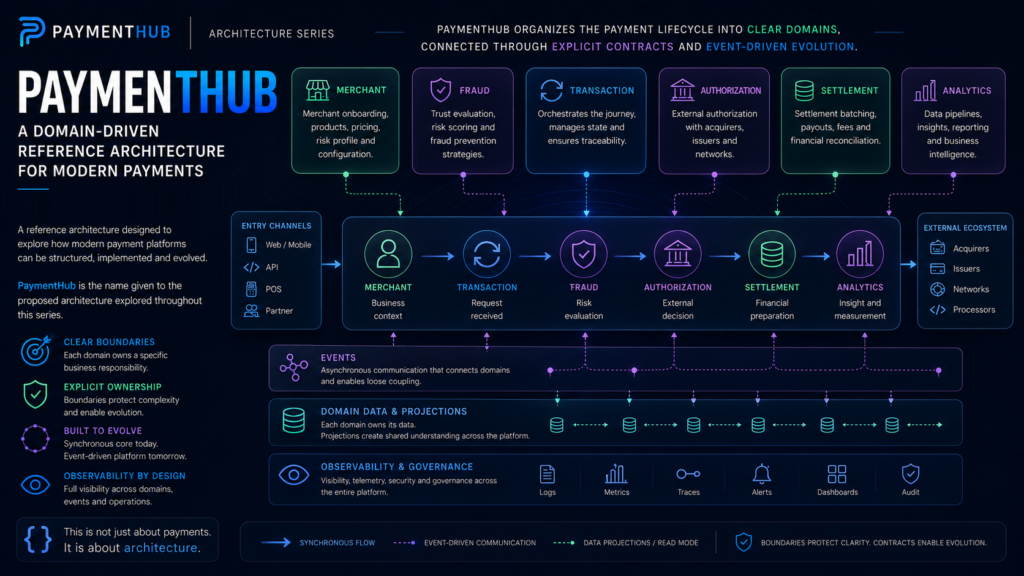
PaymentHub is a reference architecture project created to explore how modern payment platforms can be designed, structured and evolved.
What PaymentHub is
The project is not intended to be a fintech product, a commercial payment gateway or a production-ready acquiring platform. Instead, it was designed as an architectural laboratory: a practical environment where payment flows, business domains, integration patterns, distributed systems and cloud-native decisions can be studied through a realistic scenario.
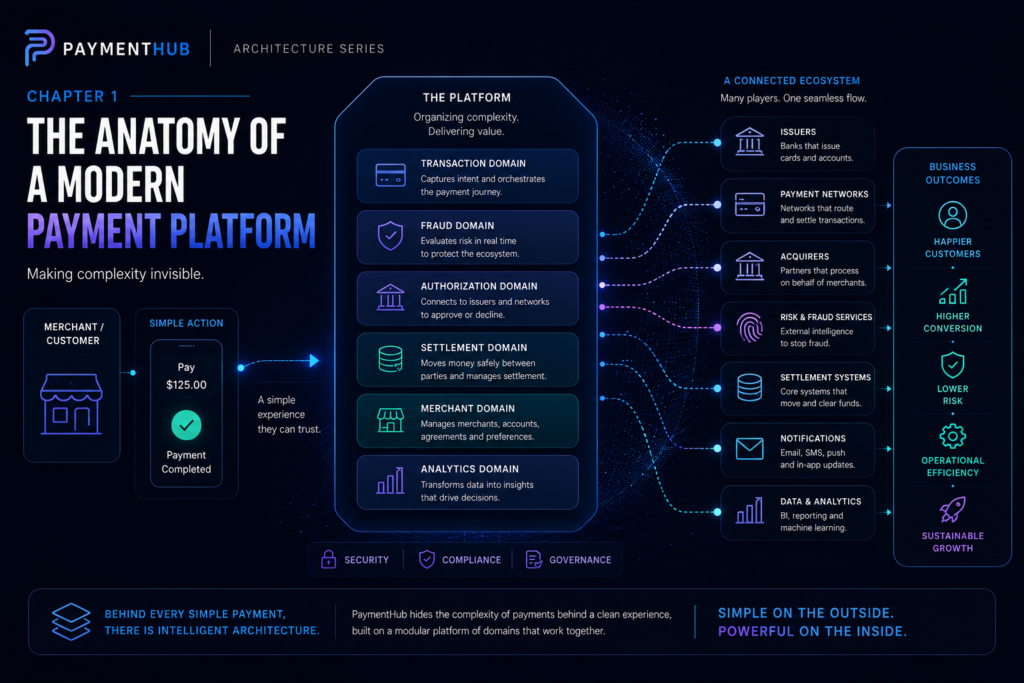
Payment systems are among the most challenging environments in software engineering. A single transaction may involve merchant context, fraud analysis, authorization decisions, financial settlement and analytical workloads. Although customers usually experience payments as simple interactions lasting only a few seconds, the architecture behind those interactions is considerably more complex.
PaymentHub was created to explore that complexity through a domain-oriented approach.
Rather than organizing the platform around technical components, PaymentHub is organized around business capabilities. Merchant, Transaction, Fraud, Authorization, Settlement and Analytics are treated as distinct domains, each with its own responsibility, lifecycle and evolution path.
The goal is not to build the most complex architecture possible.
The goal is to understand how modern payment ecosystems are structured, how responsibilities are distributed across domains and how a platform can evolve from a simple transactional flow into a scalable digital ecosystem.
In this series, each chapter explores one part of that journey: from the anatomy of a payment platform to the role of each domain, the collaboration between them and the future evolution of PaymentHub toward AWS-native and event-driven architecture.
About This Project
PaymentHub is a reference payment platform created to explore modern software architecture, Domain-Driven Design, distributed systems and AWS-native services through a realistic acquiring and payment processing scenario.
It was not designed as a fintech product or a commercial payment gateway. Instead, it was conceived as an architectural laboratory where concepts, patterns, trade-offs and platform evolution strategies can be studied and validated in a practical way.
Why PaymentHub?
Payment systems are among the most challenging environments in software engineering. A single transaction may involve multiple institutions, business rules, fraud analysis, authorization decisions, settlement processes and analytical workloads.
PaymentHub was created to explore this complexity through a domain-oriented approach. Instead of organizing the platform around technical components, the architecture is organized around business capabilities.
This approach allows each domain to evolve independently while maintaining clear responsibilities and reducing unnecessary coupling.
Although customers usually experience a payment as a simple interaction lasting only a few seconds, the architecture behind that interaction is considerably more complex.
Architectural Principles
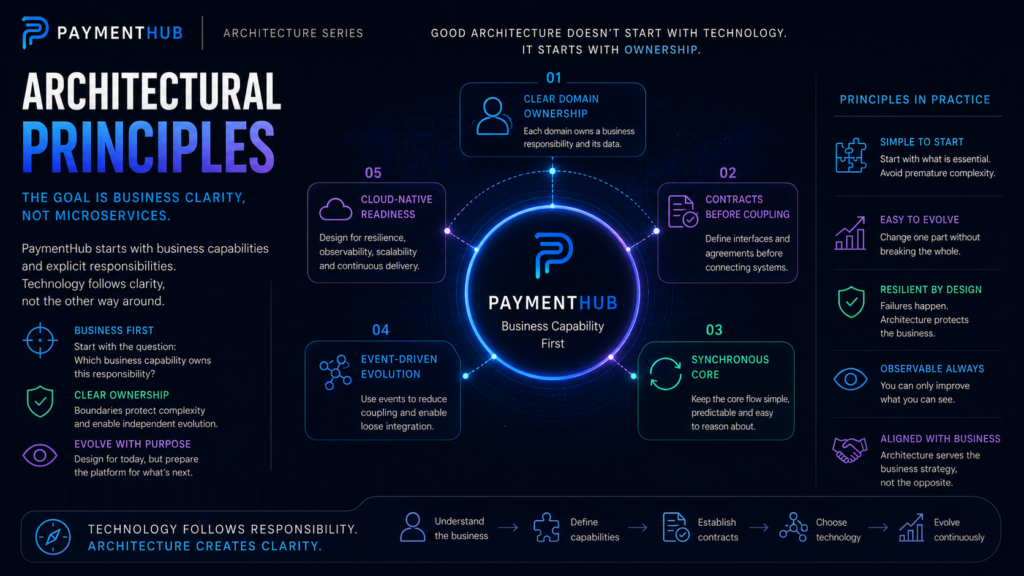
PaymentHub is guided by a set of architectural principles focused on clarity, domain ownership and evolutionary design.
Rather than starting from a specific technology stack, the platform is organized around business capabilities. Each domain owns a clear responsibility, evolves independently and collaborates with the others through explicit boundaries.
The architecture starts simple by design, prioritizing understanding before sophistication. Synchronous communication is used initially to validate the payment journey, while the platform remains prepared for future event-driven evolution and AWS-native deployment.