Chapter 1
The Anatomy of a Modern Payment Platform
Every day, millions of people make payments without giving much thought to the systems operating behind the scenes.
A card is tapped at a coffee shop. A QR Code is scanned in a mobile app. A subscription is renewed automatically during the night. In most cases, the experience is completed within a few seconds and quickly forgotten.
That simplicity is intentional.
One of the primary goals of a payment platform is to make complexity invisible. Customers should not need to understand acquirers, issuers, fraud engines, authorization networks or settlement processes. They simply expect a payment to work.
Behind that expectation, however, lies one of the most sophisticated categories of software ever built.
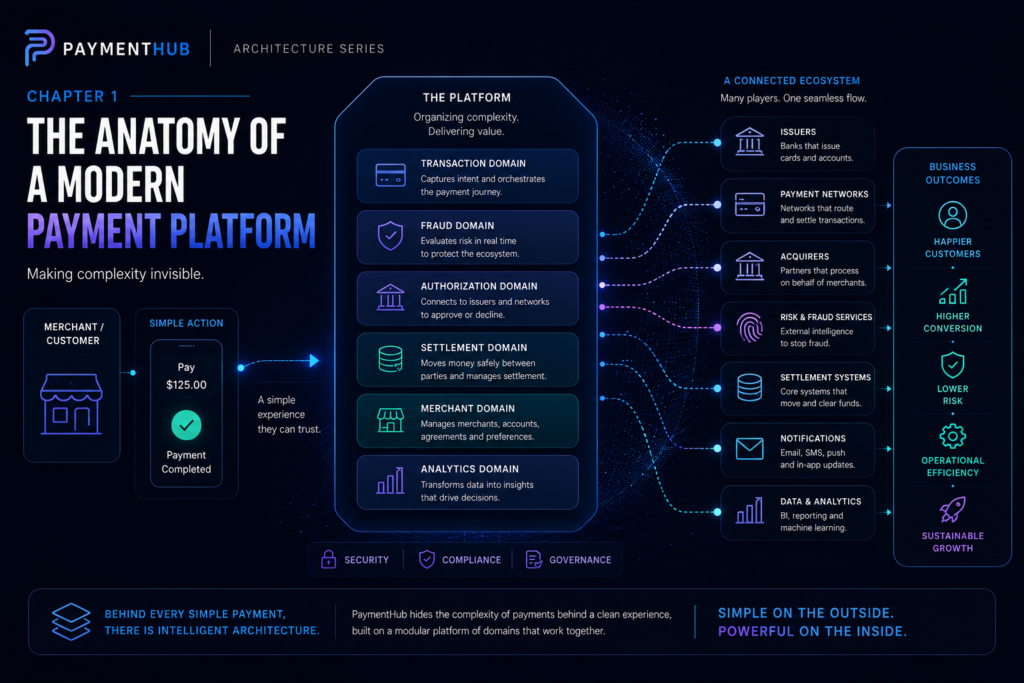
Modern payment platforms operate at the intersection of technology, finance, regulation and customer experience. They must process transactions in real time, detect suspicious behavior, communicate with external institutions, maintain financial integrity and provide operational visibility, all while remaining available and secure.
What appears to be a simple interaction between a customer and a merchant is, in reality, the result of a highly coordinated ecosystem.
Understanding that ecosystem is the first step toward understanding modern payment architecture.
A Payment Is Never Just a Payment
When a customer initiates a payment, the transaction begins a journey that extends far beyond the point of purchase.
The merchant needs confirmation that the transaction can proceed. Financial institutions need to validate the request. Fraud prevention systems need to evaluate risk. Settlement processes need to prepare future financial movements. Analytical systems need to capture information that will later support business decisions.
Each of these activities represents a distinct business capability.
Historically, many organizations attempted to centralize those responsibilities inside a single application. As payment volumes increased and business models became more sophisticated, that approach became increasingly difficult to sustain.
The result was predictable: systems grew, teams expanded and responsibilities became harder to manage.
The challenge was no longer simply processing payments.
The challenge became organizing complexity.
From Systems to Business Capabilities
One of the most significant changes in modern architecture has been the shift from technology-centric thinking to business-centric thinking.
Traditional architectures often organize systems around technical layers. User interfaces, databases, integrations and business logic are separated according to technical concerns. While this model can work effectively in smaller environments, it frequently becomes difficult to scale as organizations grow.
Payment platforms present a particularly interesting challenge because they combine multiple business concerns within a single ecosystem.
Treating all these capabilities as a single problem usually creates unnecessary coupling and slows down evolution.
Modern platforms increasingly recognize that these responsibilities deserve independent ownership.
This is where domain-oriented architecture becomes valuable.
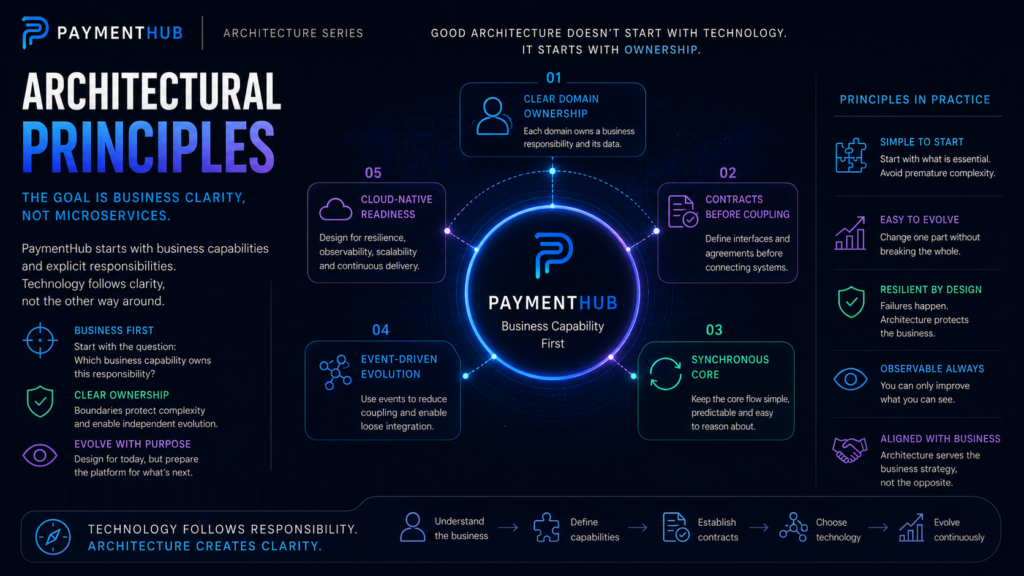
Rather than organizing systems around technical components, domain-oriented platforms organize themselves around business capabilities. Each domain owns a specific responsibility, evolves according to its own needs and collaborates with other domains through clearly defined boundaries.
The objective is not separation for its own sake.
The objective is clarity.
The Core Capabilities Behind PaymentHub
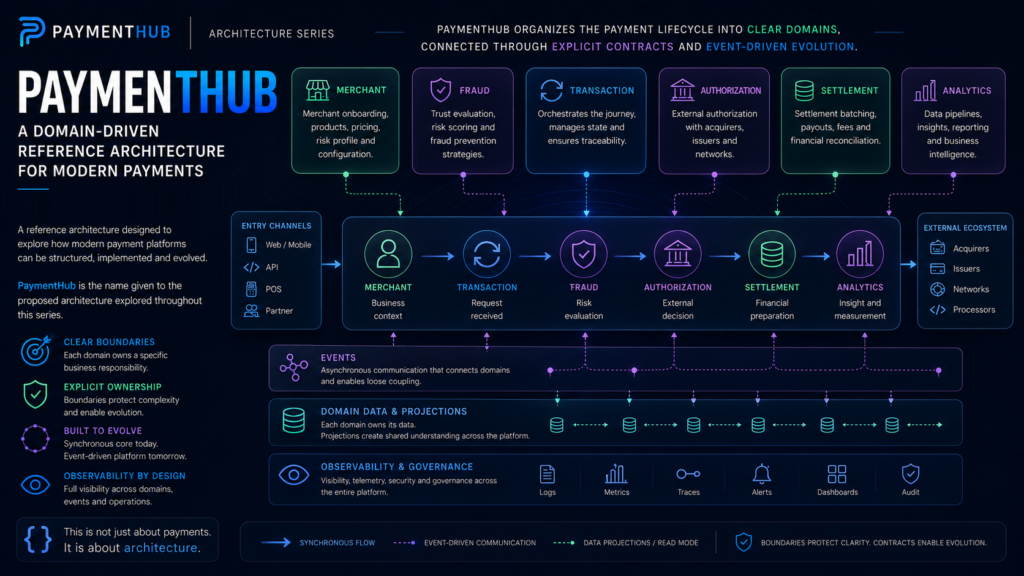
PaymentHub was designed around the idea that payment platforms should reflect business responsibilities rather than technical structures.
Instead of a single system responsible for every aspect of the payment lifecycle, the platform is organized around a set of specialized domains.
Each domain exists to solve a specific problem.
Merchant Domain manages commercial relationships and platform onboarding.
Authorization Domain communicates with the external payment network and obtains approval decisions.
Transaction Domain coordinates the payment journey and establishes transaction identity.
Settlement Domain transforms approved transactions into financial movements and merchant payouts.
Fraud Domain evaluates risk and protects the ecosystem against suspicious activity.
Analytics Domain converts operational data into business intelligence and decision support.
Individually, these domains solve different challenges.
Collectively, they form a complete payment ecosystem.
Why Architecture Matters
It is tempting to think that architecture is primarily a technology concern.
In reality, architecture is fundamentally about managing change.
A platform designed without clear boundaries eventually struggles to adapt.
New features become harder to introduce. Teams become dependent on one another. Deployments become riskier. Innovation slows down.
Good architecture does not eliminate complexity.
It organizes complexity.
The role of architecture is to create structures that allow systems to evolve without losing clarity.
For payment platforms, this principle is particularly important because change is constant. New payment methods emerge regularly. Fraud patterns evolve continuously. Regulatory environments shift over time. Competitive pressure demands faster delivery cycles.
Architectures that cannot evolve eventually become constraints on the business itself.
The Vision Behind PaymentHub
PaymentHub is not intended to be a commercial payment gateway.
It is an architectural laboratory.
The project was created to explore how modern payment ecosystems can be designed, implemented and evolved using contemporary architectural practices.
Its purpose is to provide a realistic environment where concepts such as Domain-Driven Design, distributed systems, event-driven architectures and cloud-native services can be studied through practical implementation.
The focus is not on building the largest possible platform.
The focus is on understanding why architectural decisions are made, which trade-offs they introduce and how those decisions influence future evolution.
In that sense, PaymentHub is as much about learning as it is about software.
Every domain, integration and design choice exists to support a deeper understanding of modern platform architecture.
Looking Ahead
This chapter introduced the fundamental ideas behind modern payment platforms and the architectural principles that shaped PaymentHub.
In the next chapter, we will follow the journey of a payment as it moves through the platform. Rather than examining individual domains in isolation, we will look at how they collaborate to transform a simple payment request into a complete business process.
Only after understanding the journey as a whole will we explore each domain in greater detail.
Because before understanding the parts, it is important to understand the story they are collectively trying to tell.