From LocalStack to AWS
Architecture becomes more meaningful when it is tested through implementation.
A diagram can express intent. A document can explain principles. A discussion can explore trade-offs. But only implementation reveals whether architectural decisions are understandable, practical and capable of evolving.
PaymentHub was designed with that idea in mind.
The project does not begin by trying to reproduce a full production payment platform. Instead, it begins with a controlled environment where domains, flows and architectural decisions can be explored incrementally.
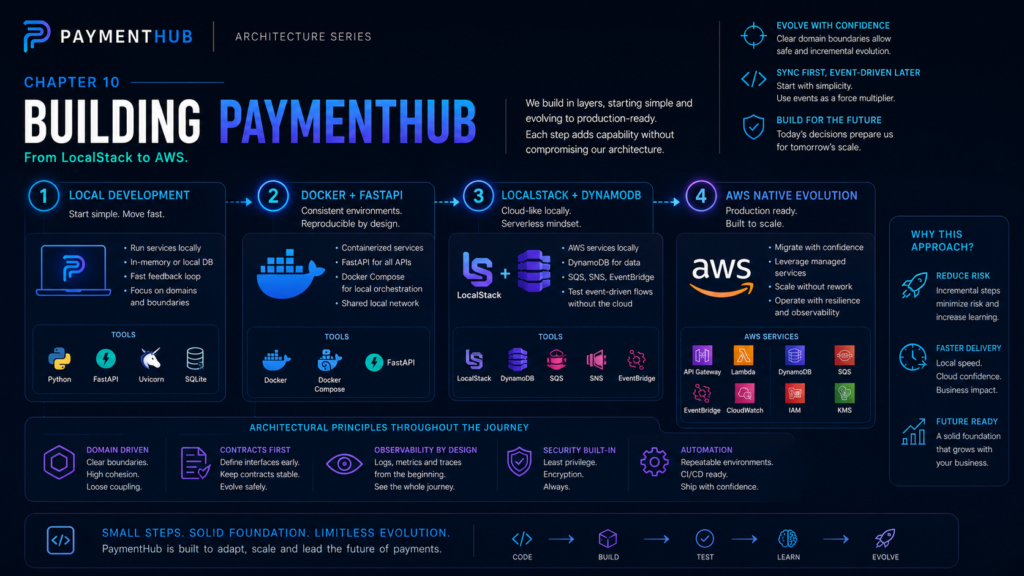
This is why the initial implementation uses technologies such as FastAPI, Docker, Docker Compose, LocalStack and DynamoDB. The objective is not to simulate every operational detail of a production platform from day one. The objective is to create a practical foundation where the architecture can be built, validated and evolved.
Starting Simple on Purpose
One of the most important decisions in PaymentHub is to start simple.
This does not mean ignoring future complexity. It means refusing to introduce complexity before the architecture has earned it.
In early stages, the most valuable thing is clarity. The platform needs clear domains, understandable flows, explicit responsibilities and enough infrastructure to validate the core payment journey. Introducing advanced deployment models, complex event topologies or production-grade observability too early can hide the architectural learning behind operational overhead.
A simple local environment allows faster experimentation.
It becomes easier to change a domain boundary, adjust a flow, test a persistence model or evaluate a communication pattern. This matters because PaymentHub is not only a software project. It is also a learning environment for architectural decision-making.
The first goal is not scale.
The first goal is understanding.
Why LocalStack Matters
LocalStack plays an important role in the PaymentHub journey because it allows AWS concepts to be explored without requiring immediate cloud deployment.
This creates a useful bridge between local development and cloud-native thinking.
With LocalStack, the platform can experiment with services such as DynamoDB, queues, events and other AWS-like capabilities while keeping the development environment accessible. This supports the learning objective of the project and allows infrastructure decisions to be tested gradually.
The value is not only technical convenience.
It is architectural discipline.
By designing with AWS evolution in mind from the beginning, the platform avoids becoming purely local in its assumptions. At the same time, by not moving everything to AWS immediately, it avoids unnecessary cost, complexity and operational distraction during the early design phase.
This balance is important.
PaymentHub is cloud-oriented, but it is not cloud-rushed.
Containers, Services and Domain Boundaries
The current implementation treats each domain as an independent service running in containers.
This model reinforces the architectural boundaries defined earlier in the project. Each domain has its own responsibility, its own code structure and its own execution context. This makes the separation of concerns visible not only in diagrams, but also in the implementation.
However, the important point is not the container itself.
The important point is the boundary.
Containers provide a practical way to run domains independently, but the architecture should not depend on containers as a conceptual requirement. In the future, some capabilities could remain containerized, while others might evolve toward serverless functions, managed workflows or event-driven consumers.
A mature architecture should allow deployment models to evolve without destroying domain clarity.
This is another reason PaymentHub emphasizes business boundaries before technical patterns.
Synchronous First, Event-Driven Later
PaymentHub begins with primarily synchronous communication because it makes the initial journey easier to follow.
This is especially useful in a learning-oriented architecture. When a payment request enters the platform, synchronous flows make it easier to observe the sequence of decisions, understand dependencies and validate the responsibilities of each domain.
However, synchronous communication has limits.
As the platform grows, some interactions will benefit from asynchronous processing. Analytics should not block payment execution. Settlement events may not need to happen in the same real-time path as authorization. Notifications, audit streams and downstream projections can often be decoupled from the immediate transaction flow.
This is where event-driven architecture becomes valuable.
The key is timing.
Introducing events too early can make the system harder to understand. Introducing them too late can make the platform difficult to scale. PaymentHub approaches this as an evolutionary decision: start with clarity, then introduce events where they solve a real architectural problem.
AWS Evolution Roadmap
As PaymentHub evolves, its local architecture can gradually move toward AWS-native capabilities.
API entry points can evolve toward API Gateway or Application Load Balancers. Containerized services can run on ECS or another managed compute option. DynamoDB can continue supporting high-scale key-value access patterns. EventBridge and SQS can support asynchronous communication between domains. S3, Glue, Athena and QuickSight can support analytical workloads. CloudWatch and X-Ray can improve observability.
The specific roadmap should remain flexible.
The purpose of the roadmap is not to force every AWS service into the platform. The purpose is to understand which cloud capabilities support the architecture when the platform reaches the right level of maturity.
Cloud services should be introduced as answers to architectural needs, not as decorative elements in a diagram.
This principle keeps PaymentHub grounded.
Trade-offs as the Core of Architecture
Building PaymentHub highlights a simple but important truth: architecture is a series of trade-offs.
Every decision creates benefits and constraints.
Synchronous communication improves clarity but can increase coupling. Event-driven communication improves decoupling but adds operational complexity. DynamoDB can provide scalability and performance for certain access patterns, but it requires careful modeling. Containers provide isolation and portability, but they introduce deployment and operational concerns. Serverless services reduce infrastructure management, but they require different design assumptions.
There is rarely a perfect answer.
There is usually a better answer for a specific moment, context and objective.
This is why PaymentHub is designed to evolve. The architecture does not need to solve every future problem today. It needs to preserve enough clarity and flexibility so that future decisions remain possible.
Architect’s Note
A useful way to evaluate an architecture is not to ask whether it looks advanced.
Ask whether it can explain its own decisions.
Why is this domain separate? Why is this interaction synchronous? Why is this data stored here? Why is this service independent? Why is this complexity necessary now?
If the architecture cannot answer those questions, sophistication may simply be accidental complexity.
PaymentHub is intentionally built around explainable decisions.
That makes the platform easier to teach, easier to evolve and easier to defend in architectural discussions.
Looking Ahead
Building PaymentHub is not the end of the journey.
It is the mechanism through which the architecture becomes real.
Starting locally allows the platform to develop clarity. Moving gradually toward AWS allows the architecture to explore scale, resilience, automation and operational maturity. Introducing events allows the ecosystem to become more decoupled. Improving analytics allows the platform to learn from its own behavior.
The final chapter looks beyond the current architecture and explores the future of PaymentHub.
Because every platform begins with a set of capabilities, but the strongest platforms are designed to grow beyond their first version.