Where Money Actually Moves
Approval is one of the most visible moments in a payment journey, but it is not the end of the financial process.
When a customer sees an approved message, the experience feels complete. The purchase was accepted, the merchant can proceed with the sale and the customer can move on. From the perspective of the user experience, the payment worked.
From the perspective of the platform, however, something important still needs to happen.
The financial consequences of that approval need to be organized, reconciled and eventually settled.
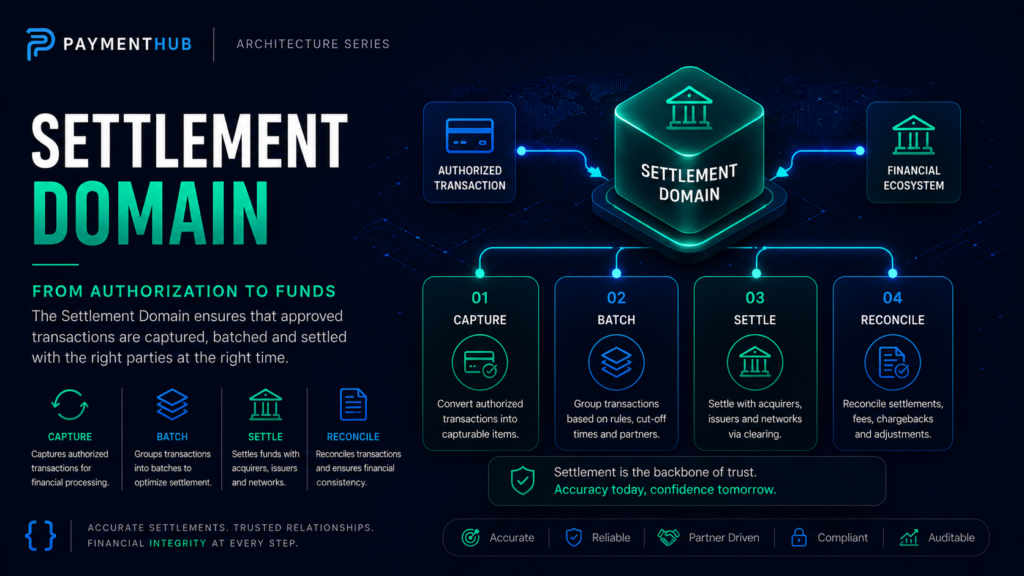
This is where the Settlement Domain becomes essential.
Authorization moves information. Settlement moves money.
That distinction is one of the most important concepts in payment architecture. Without it, it is easy to assume that approving a transaction and paying a merchant are part of the same process. In reality, they belong to different moments of the lifecycle, involve different rules and require different architectural concerns.
The Authorization Domain answers whether a payment can proceed. The Settlement Domain prepares what must happen financially after that decision has been made.
The Gap Between Approval and Payment
A successful authorization creates a commitment, not an immediate transfer of funds to the merchant.
Depending on the business model, payment method, provider, region and contractual rules, the movement of money may happen later. It may depend on capture, clearing, reconciliation, fees, settlement windows, merchant agreements and operational controls.
This gap between approval and payment is where much of the financial complexity of a payment platform lives.
For customers, this complexity should remain invisible. For merchants, however, it is extremely important. They need to know when they will receive funds, which transactions were included, which fees were applied and whether any adjustments, chargebacks or reversals affected the final amount.
A payment platform that cannot explain settlement clearly creates operational friction for the business it is supposed to serve.
This is why the Settlement Domain must be treated as a first-class capability, not as an afterthought attached to transaction processing.
Financial Integrity as an Architectural Concern
Settlement is not only a business process. It is also an architectural responsibility.
The platform must preserve enough information to explain how an approved transaction becomes part of a financial position. It must connect transaction history with merchant agreements, fee rules, settlement calendars and reconciliation processes.
This requires a different mindset from real-time authorization.
Authorization is usually optimized for speed, availability and immediate decisioning. Settlement is optimized for correctness, traceability and financial integrity.
Both are critical, but they operate under different pressures.
A slow authorization can damage customer experience. An incorrect settlement can damage trust, financial reporting and merchant relationships.
The Settlement Domain exists to ensure that financial outcomes remain understandable and auditable as the platform grows.
From Transaction to Financial Position
Inside PaymentHub, the Settlement Domain represents the transition from operational events to financial consequences.
A transaction may be approved, but the platform still needs to determine how that transaction affects the merchant. The answer may depend on business rules such as fees, payment method configuration, settlement timing and contractual conditions.
At a basic level, the domain must help answer questions such as:
- Which approved transactions are eligible for settlement?
- Which merchant should receive the funds?
- Which fees should be applied?
- Which values need to be reconciled?
- Which financial records must be produced?
- Which events should be exposed to downstream systems?
These questions are not simply technical details. They represent the bridge between a payment event and the financial reality of the merchant.
As the platform matures, this domain can evolve toward more sophisticated capabilities such as ledger integration, double-entry accounting, payout scheduling, dispute handling and financial reconciliation workflows.
The important point is that these concerns should not be hidden inside transaction orchestration or authorization logic.
They deserve their own domain.
Settlement Is Where Trust Becomes Operational
Payment platforms depend on trust at multiple levels.
Fraud protects trust before approval. Authorization establishes trust between institutions during the decision. Settlement sustains trust after the transaction by ensuring that the financial outcome is consistent with what the platform promised.
For merchants, this is where the platform becomes real.
A merchant may care about approval rates, fraud protection and customer experience, but ultimately they need confidence that funds will be settled correctly. If the merchant cannot trust the financial process, the rest of the platform loses credibility.
This is one reason why settlement deserves architectural attention.
It is not the most visible part of the payment journey, but it is one of the most important for long-term platform reliability.
Good settlement architecture gives the business the ability to explain money movement with confidence.
Batch, Events and Future Evolution
Settlement processes often introduce a different rhythm into the platform.
While authorization tends to happen in real time, settlement may involve batch processing, scheduled workflows, reconciliation windows and asynchronous events. This makes the Settlement Domain a natural candidate for future event-driven and workflow-based evolution.
In early versions of PaymentHub, the settlement model can remain intentionally simple. The goal is to establish the responsibility clearly before introducing unnecessary complexity.
As the platform evolves, settlement-related events may become part of the broader ecosystem:
- Transaction captured
- Settlement prepared
- Fees calculated
- Merchant payout scheduled
- Reconciliation completed
- Settlement failed
- Adjustment created
These events can support analytics, operations, financial reporting and downstream integrations without requiring every domain to be tightly coupled to the settlement process.
This is a good example of evolutionary architecture in practice.
The domain starts with a clear responsibility and gains sophistication as the platform requires it.
Architect’s Note
A useful way to understand settlement is to separate the emotional experience of payment from the financial process behind it.
For the customer, the payment ends when approval appears.
For the merchant, the payment ends when the money is received and reconciled.
A strong payment platform must support both perspectives.
It must deliver a fast and simple experience at the point of purchase, while also maintaining a reliable financial process behind the scenes. The Settlement Domain exists because these two perspectives are connected, but not identical.
Treating them as the same concern usually leads to architectural confusion.
Separating them creates clarity.
Looking Ahead
The Settlement Domain completes one of the most important transitions in the payment journey: the movement from authorization to financial outcome.
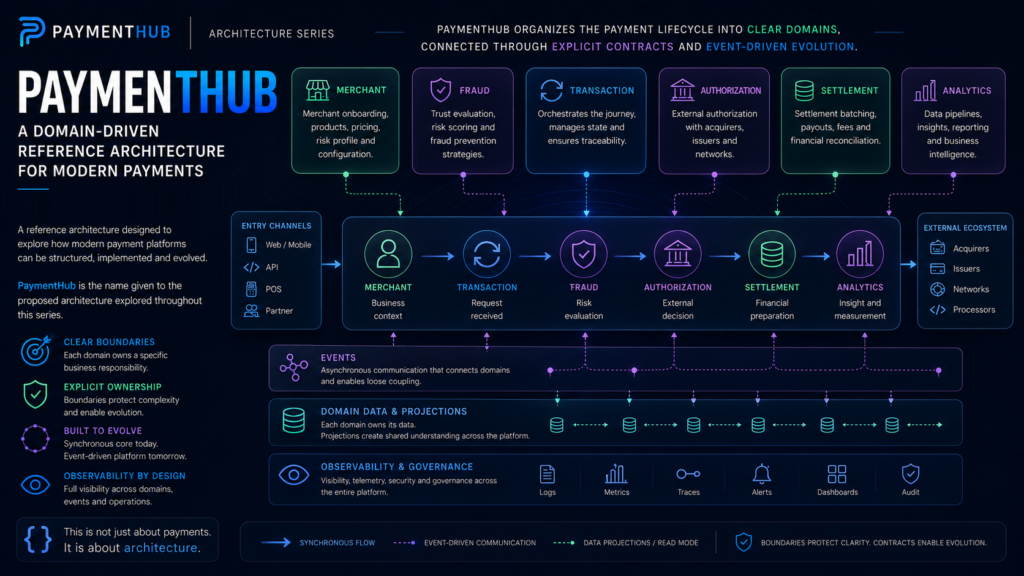
At this point, PaymentHub has coordinated the transaction, evaluated trust, obtained a decision and prepared the financial consequences of that decision.
The next chapter changes the perspective.
Instead of following the transaction from the inside of the platform, we return to the reason the platform exists in the first place: the merchant.
Every domain in PaymentHub ultimately serves the merchant relationship, even when that relationship is not immediately visible in the transaction flow.
That is why the next domain is central to the ecosystem.