Chapter 4 — Fraud Domain
Trust Before Approval
A payment platform cannot treat every transaction as equal.
Some transactions follow expected patterns. They come from known customers, familiar devices, regular merchants and predictable purchase behaviors. Others arrive with signals that require caution: unusual amounts, unexpected locations, new devices, repeated attempts or behavior that does not match historical context.
From the customer’s perspective, all of these situations may look the same. A payment is initiated and the platform responds within seconds. Inside the platform, however, the difference between a trusted transaction and a suspicious one is significant.
This is where the Fraud Domain becomes essential.
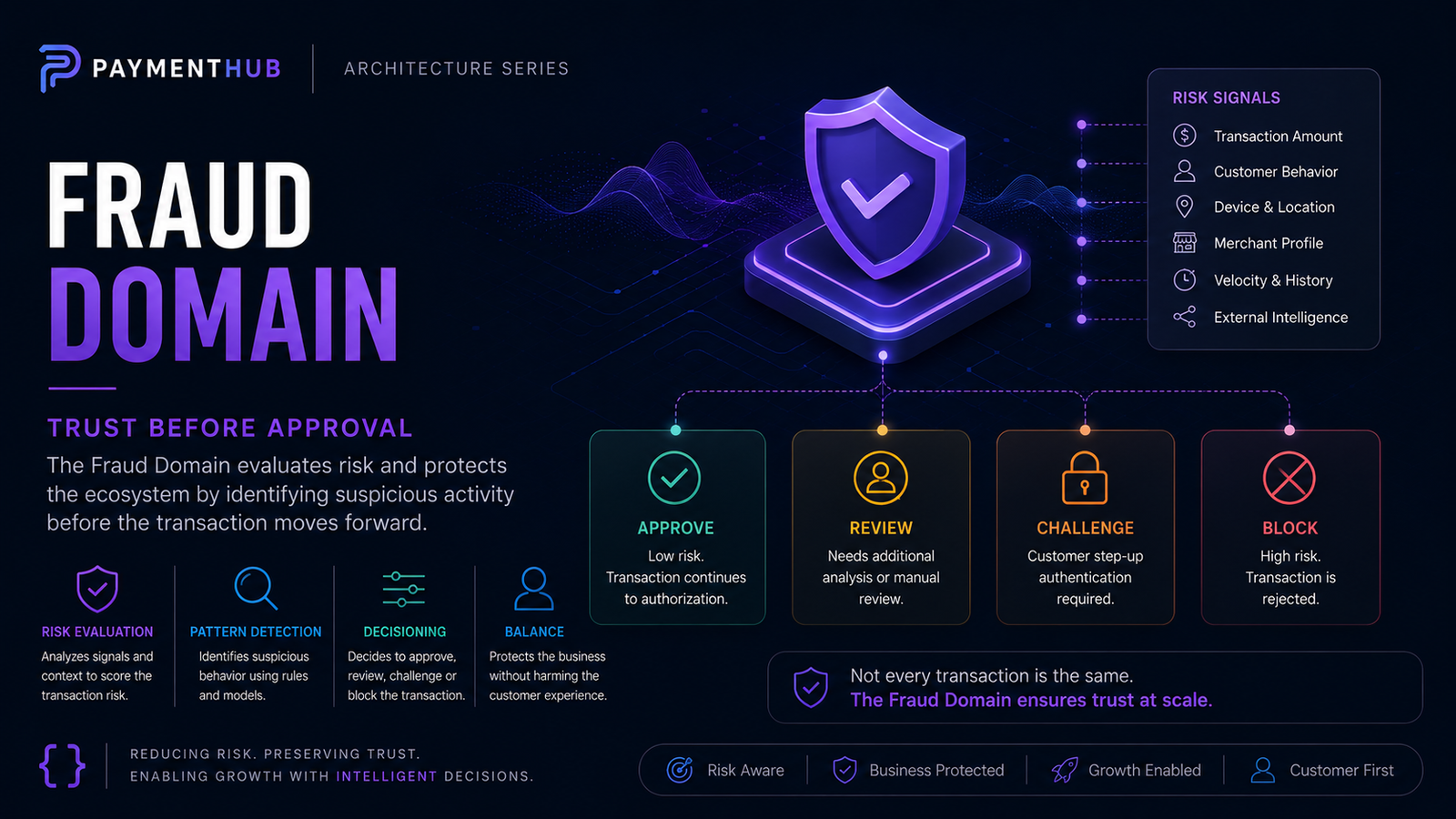
The role of the Fraud Domain is not simply to block transactions. Its responsibility is to evaluate trust. Before a payment platform asks whether a transaction can be approved by the financial ecosystem, it must first ask whether the transaction should be allowed to continue through the journey.
This distinction is important because fraud prevention is not only a technical capability. It is a business balancing act.
A platform that is too permissive exposes merchants, customers and financial institutions to losses. A platform that is too restrictive blocks legitimate customers, reduces conversion and damages the merchant experience. The best fraud strategies operate between these extremes, protecting the ecosystem while remaining almost invisible to legitimate users.
Fraud Is a Domain, Not a Feature
In many systems, fraud prevention begins as a set of rules added to the transaction flow. At first, this may be enough. A few simple checks can identify obvious problems and reduce basic risk.
Over time, however, fraud becomes more complex.
Attack patterns change. Fraudsters adapt. Merchants operate in different segments with different risk profiles. Payment methods introduce different behaviors. Customer expectations evolve. What works for one business model may be too aggressive or too weak for another.
At that point, fraud prevention can no longer be treated as a small feature inside the transaction flow. It becomes a domain of its own.
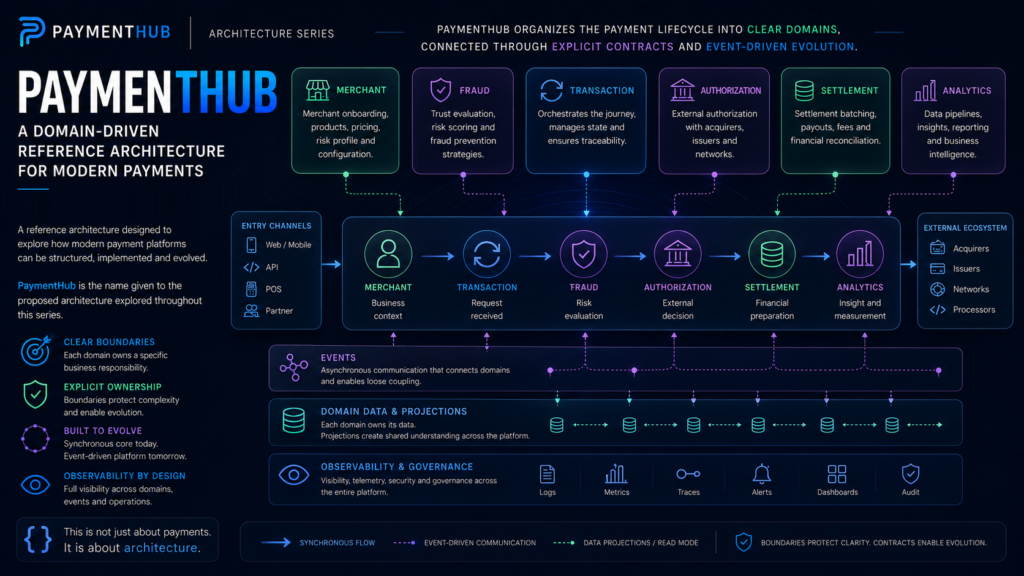
This is the approach used in PaymentHub.
The Fraud Domain owns the responsibility of evaluating risk. It can evolve its rules, scoring models, signals and decision strategies without forcing the Transaction Domain to absorb fraud-specific complexity. This separation keeps the payment journey cleaner and gives fraud prevention the autonomy it needs to mature.
The Transaction Domain coordinates the journey.
The Fraud Domain evaluates trust.
Keeping those responsibilities separate helps the platform evolve without turning orchestration into a container for every business rule.
The Question Fraud Answers
Every domain in a payment platform should answer a clear question.
The Fraud Domain answers one of the most important questions in the journey:
Can we trust this transaction?
This question is different from asking whether a payment can be approved. Authorization depends on the external payment ecosystem, such as acquirers, issuers, networks or payment providers. Fraud evaluation depends on risk signals, behavior, merchant context and platform intelligence.
A transaction may be technically authorizable and still be risky.
A customer may have available funds. A card may be valid. The authorization network may be capable of approving the transaction. Even then, the platform may decide that the risk is too high and that the transaction should not proceed.
Separating this question allows the platform to make better decisions.
Fraud is not only about detecting what is wrong. It is also about understanding what is normal.
A coffee purchase made every morning at the same merchant may represent a low-risk pattern. A high-value purchase attempted repeatedly from a new device may deserve additional attention. A transaction from a merchant category with historically higher risk may require different thresholds than a recurring subscription from a known account.
The value of the Fraud Domain lies in its ability to interpret these signals in context.
Signals, Context and Risk
Fraud decisions are rarely based on a single piece of information.
A modern fraud capability usually combines multiple signals to produce a risk assessment. These signals may include transaction amount, merchant profile, customer behavior, device information, geolocation, historical activity, velocity patterns and previous outcomes.
Individually, each signal may tell only a small part of the story. Together, they help the platform understand whether a transaction behaves as expected or deserves additional scrutiny.
This is why context matters.
The same transaction amount may be normal for one merchant and unusual for another. The same customer behavior may be expected in one channel and suspicious in another. The same retry pattern may indicate a temporary issue or an automated attack depending on surrounding signals.
A strong Fraud Domain does not simply apply rules mechanically. It interprets behavior within the context of the payment ecosystem.
In early stages, this interpretation may begin with deterministic rules and simple scoring. As the platform evolves, the domain may incorporate more advanced capabilities such as behavioral models, feature stores, machine learning, real-time signals and feedback loops from confirmed fraud cases.
The architecture should allow that evolution without requiring the entire payment platform to be redesigned.
Protecting Without Creating Friction
Fraud prevention has a unique challenge: when it works well, most customers never notice it.
This makes it different from many other platform capabilities. A successful analytics dashboard is visible. A successful onboarding flow is visible. A successful authorization decision is visible to the customer and merchant.
A successful fraud decision is often invisible.
The legitimate customer simply completes the purchase.
That invisibility is part of the value.
If every transaction required additional verification, the platform would become safer in one sense but worse in another. Conversion would drop, merchants would lose sales and customers would associate the payment experience with friction.
The Fraud Domain must therefore protect the ecosystem without becoming an obstacle to normal business.
This is one of the reasons why fraud should be modeled as a specialized domain. Its decisions require a different kind of thinking from transaction orchestration or authorization integration. It must combine technical signals, business risk, customer experience and merchant impact into a single decision strategy.
Designing for Evolution
Fraud is never finished.
A fraud strategy that works today may become insufficient tomorrow. New attack patterns appear. New channels are introduced. New merchants join the platform. New payment methods change user behavior.
For this reason, the Fraud Domain in PaymentHub should be designed as an evolving capability.
The initial implementation may begin with straightforward rules and risk scores. That is enough to establish the domain boundary and validate the role of fraud evaluation in the payment journey. Over time, however, the domain can mature into a more sophisticated risk platform.
Possible evolution paths include:
- velocity checks across merchants, customers and payment instruments
- merchant-specific risk profiles
- configurable rules engines
- behavioral analysis
- device intelligence
- machine learning models
- case management workflows
- feedback loops from chargebacks and confirmed fraud
The important point is not to implement all of this immediately.
The important point is to create an architecture where these capabilities have a natural place to grow.
PaymentHub follows an evolutionary approach. The Fraud Domain does not need to start as a complete risk platform, but it should be designed so that it can become one.
Architect’s Note
One of the most useful distinctions in payment architecture is the separation between fraud decisions and authorization decisions.
Fraud asks whether the platform should trust the transaction.
Authorization asks whether the external payment ecosystem will approve it.
When these responsibilities are mixed, the architecture becomes harder to reason about. A decline may represent risk, insufficient funds, issuer behavior, network failure or provider timeout. Without clear boundaries, these outcomes become difficult to analyze and improve.
By separating Fraud and Authorization, PaymentHub creates a cleaner decision model.
The platform can understand whether a transaction was stopped because of risk or declined by the external payment ecosystem. That distinction is essential for analytics, operations, merchant communication and future optimization.
Clear questions create clearer systems.
Looking Ahead
The Fraud Domain introduces trust into the payment journey.
It evaluates whether a transaction should continue before the platform requests an authorization decision from the external payment ecosystem. In doing so, it protects customers, merchants and the platform itself while preserving the experience for legitimate transactions.
After trust has been evaluated, the journey moves to the next critical step.
The platform must now ask the financial ecosystem whether the payment can be approved.
That responsibility belongs to the Authorization Domain.