How the Domains Work Together
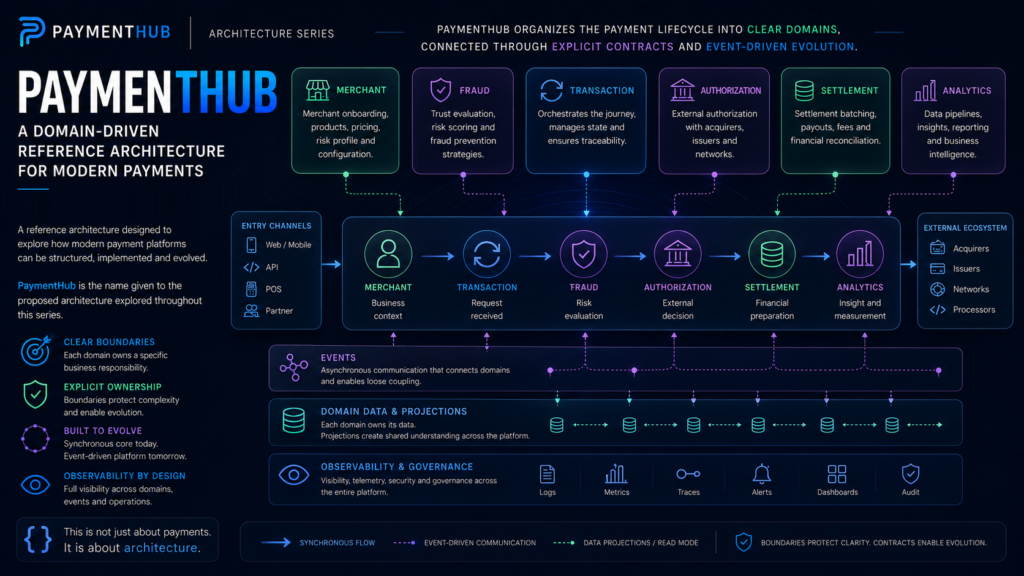
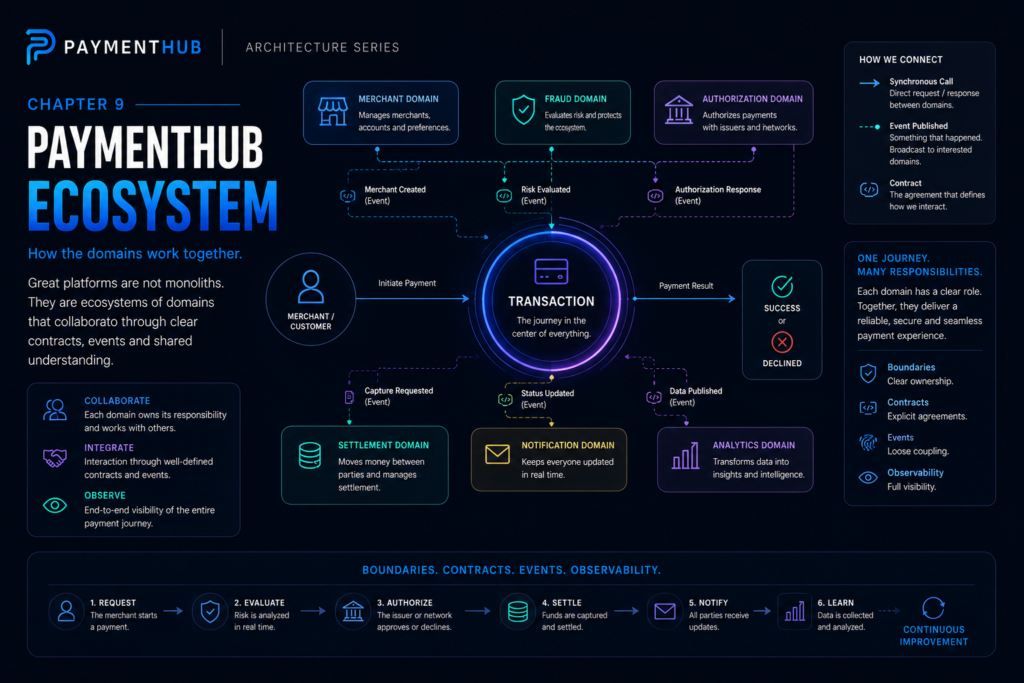
After exploring each domain individually, it becomes easier to understand their specific responsibilities. The Merchant Domain provides business context. The Transaction Domain coordinates the journey. The Fraud Domain evaluates trust. The Authorization Domain obtains external decisions. The Settlement Domain prepares financial outcomes. The Analytics Domain transforms operational data into insight.
Individually, each domain solves an important problem.
Together, they form the PaymentHub ecosystem.
This distinction is important because architecture is not created by simply drawing boxes around services. A diagram may show components, but the real architecture lives in the relationships between them. It exists in the boundaries, contracts, responsibilities and decisions that determine how the platform behaves as it grows.
PaymentHub is not designed as a collection of isolated services. It is designed as a set of collaborating business capabilities.
Domains as Business Responsibilities
A domain should not exist because a system needs another deployable component.
A domain should exist because the business contains a responsibility important enough to deserve ownership.
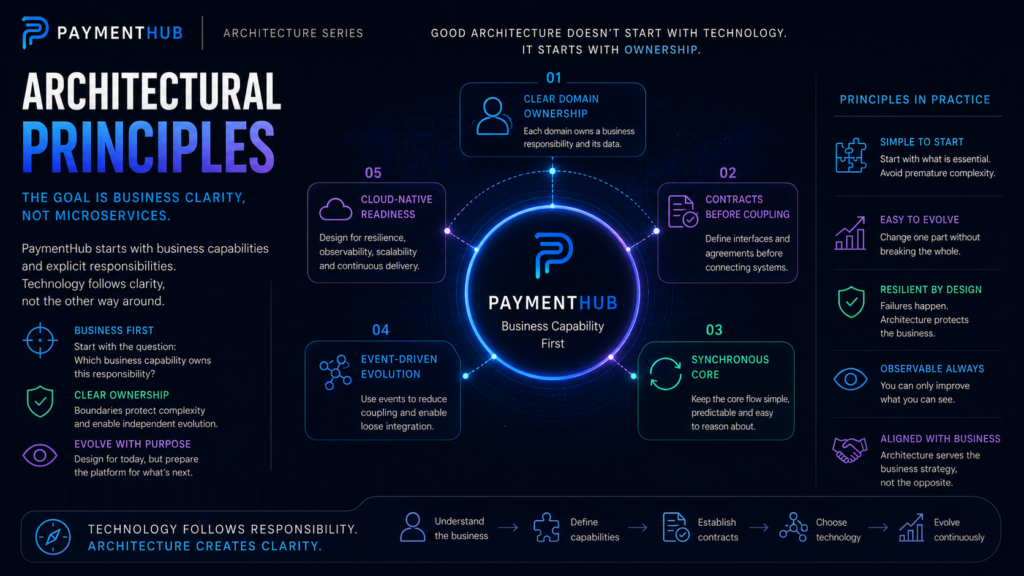
This is the central idea behind the PaymentHub ecosystem. Each domain represents a business responsibility with its own language, rules, lifecycle and evolution path. The platform becomes easier to reason about because responsibility is distributed according to business meaning rather than technical convenience.
This approach creates clarity.
When a transaction needs coordination, the responsibility belongs to the Transaction Domain. When risk needs to be evaluated, the responsibility belongs to the Fraud Domain. When external approval is required, the Authorization Domain becomes responsible. When financial outcomes need to be prepared, the Settlement Domain owns that concern. When the business needs to understand performance, the Analytics Domain provides that view.
The result is not only technical separation.
It is organizational and conceptual clarity.
Collaboration Without Confusion
The greatest challenge in domain-oriented architecture is not creating domains.
It is making them collaborate without allowing their responsibilities to become blurred.
In PaymentHub, the domains must work together to complete a payment journey, but that collaboration should not erase ownership. The Transaction Domain may coordinate the flow, but it should not decide fraud strategy. The Fraud Domain may influence the journey, but it should not own authorization integration. The Authorization Domain may return a decision, but it should not manage settlement. The Settlement Domain may depend on approved transactions, but it should not reinterpret fraud logic.
Good architecture creates collaboration without confusion.
This is achieved through clear contracts, explicit state transitions and carefully designed interactions. Each domain should know enough about the journey to participate effectively, but not so much that it becomes coupled to every internal detail of the others.
In practical terms, this means that the PaymentHub ecosystem should evolve toward well-defined APIs, domain events, shared identifiers and observability patterns that preserve autonomy while enabling coordination.
The Payment Lifecycle as a Shared Story
One useful way to understand the ecosystem is to think of the payment lifecycle as a shared story.
No single domain owns the entire story.
Each domain contributes a chapter.
The Merchant Domain defines the business context. The Transaction Domain begins the operational narrative. The Fraud Domain adds a trust decision. The Authorization Domain connects the platform to the external financial ecosystem. The Settlement Domain gives the transaction financial consequence. The Analytics Domain allows the platform to learn from what happened.
This shared story gives the architecture coherence.
Without it, domains risk becoming disconnected technical services. With it, each domain understands its role in the broader business outcome.
This is why the payment journey is so important. It provides a common mental model that connects business stakeholders, architects, engineers and product teams.
A platform becomes easier to evolve when everyone understands the story it is trying to tell.
From Synchronous Collaboration to Events
The initial version of PaymentHub begins with a simpler communication model. Domains can communicate synchronously while the boundaries, responsibilities and behaviors are still being validated.
This is intentional.
Starting with synchronous collaboration can be useful when the goal is learning, clarity and fast iteration. It allows the platform to focus on business design before introducing more complex operational patterns.
However, as the ecosystem matures, events become increasingly valuable.
Events allow domains to communicate important business facts without forcing every participant into the same execution path. A transaction can be created. Fraud can be evaluated. Authorization can be completed. Settlement can be prepared. Analytics can consume those facts asynchronously and build decision-oriented views.
This evolution supports scalability, resilience and decoupling.
The important point is that events should reflect business meaning. They should not simply expose technical implementation details. A good domain event tells the ecosystem that something relevant happened in the business lifecycle.
When events are designed this way, they become part of the platform language.
Observability Across the Ecosystem
As PaymentHub evolves, observability becomes an ecosystem concern rather than a service-level concern.
It is not enough to know whether a single service is healthy. The platform must be able to understand whether the payment journey is healthy.
Can transactions be traced across domains? Can failures be correlated? Can authorization timeouts be connected to merchant impact? Can fraud decisions be analyzed alongside approval rates? Can settlement issues be traced back to specific transaction patterns?
These questions require observability across boundaries.
A domain-oriented platform needs logs, metrics and traces, but it also needs business observability. Technical signals explain how systems behave. Business signals explain how the platform performs.
In PaymentHub, the ecosystem view encourages both.
The goal is not only to keep services running. The goal is to understand whether the payment lifecycle is working as expected.
Nota do Arquiteto
A common mistake in architecture discussions is treating service decomposition as the final goal.
It is not.
Splitting a system into services without clear business boundaries often creates distributed complexity rather than architectural clarity.
The real goal is not distribution.
The real goal is responsibility alignment.
PaymentHub uses domains because they help organize responsibilities. Whether those domains are implemented as independent services, modules, containers or serverless functions is an implementation decision that can evolve over time.
The boundary matters before the deployment model.
Looking Ahead
The PaymentHub ecosystem brings together the domains explored throughout the previous chapters and shows how they collaborate to support a complete payment lifecycle.
At this stage, the architecture is no longer only a conceptual model. It becomes something that can be implemented, tested and evolved.
The next chapter focuses on that implementation journey.
PaymentHub begins in a local environment with Docker, FastAPI, LocalStack and DynamoDB. Over time, it can evolve toward AWS-native services, event-driven communication, stronger observability and more sophisticated deployment models.
This evolution is not only technical.
It reflects one of the most important ideas in architecture.
Systems should grow with understanding.