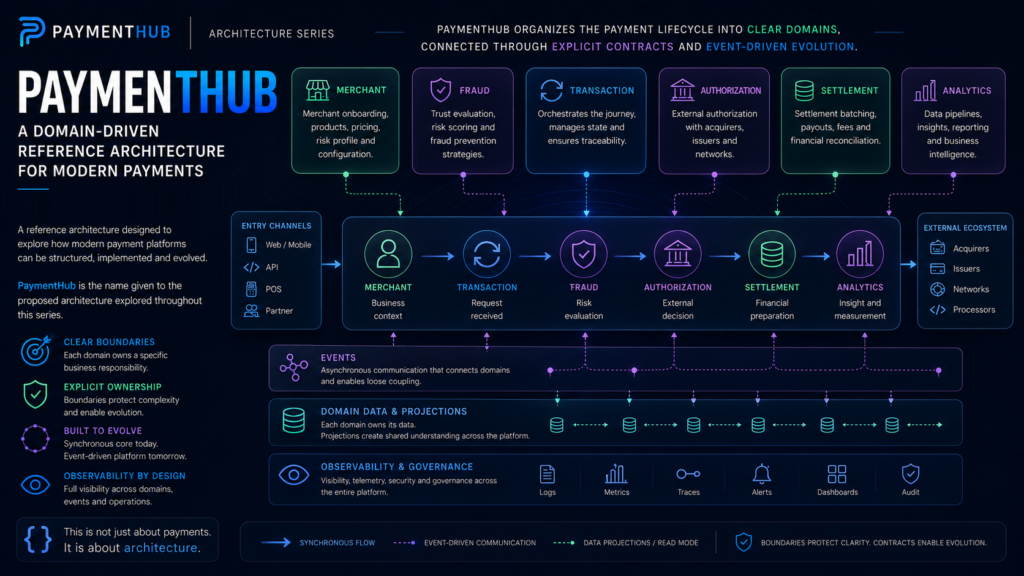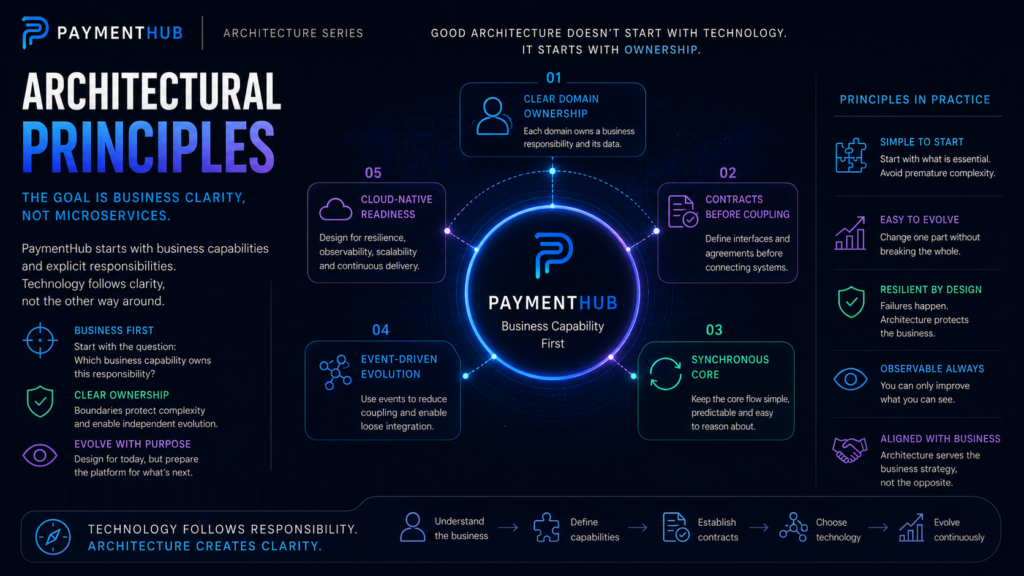
The Decision Point
After a transaction has been created, structured and evaluated from a risk perspective, the payment journey reaches one of its most visible moments: authorization.
This is the point where the platform asks the external payment ecosystem whether the transaction can proceed. From the customer’s perspective, this is often the moment that determines whether a purchase is approved or declined. From the merchant’s perspective, it is the moment that confirms whether the sale can continue.
However, authorization is more than a simple approval request.
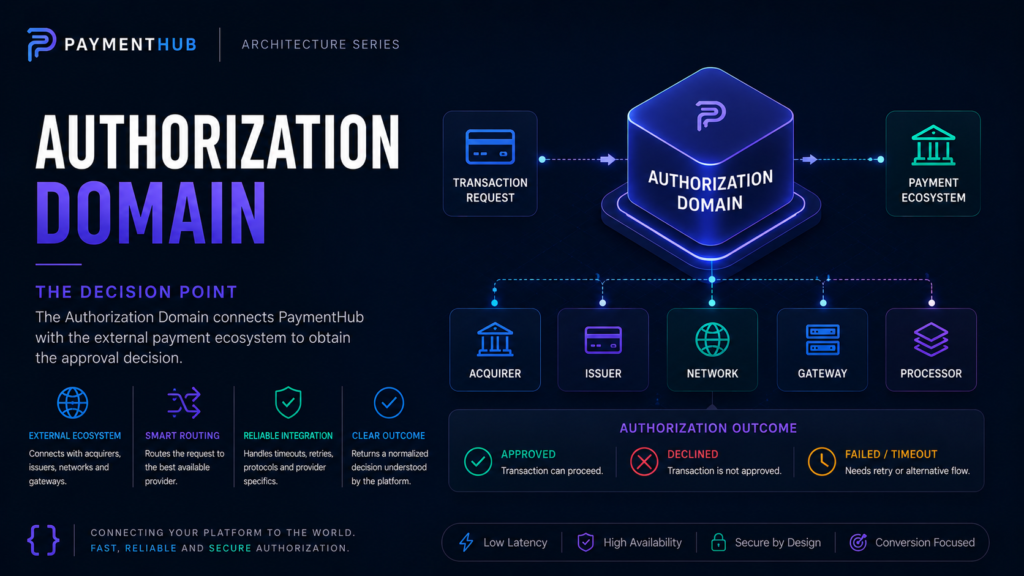
It is the point where a modern payment platform connects with financial institutions, networks, processors and external systems that may operate under different protocols, timelines and operational constraints. The Authorization Domain exists to manage this complexity and transform it into a decision the rest of the platform can understand.
In PaymentHub, the Authorization Domain represents the boundary between the internal payment journey and the external payment ecosystem.
That boundary is one of the most important parts of the architecture.
Authorization Is an Integration Problem
Many people think of authorization as a business decision: approved or declined.
That view is correct, but incomplete.
Authorization is also a complex integration problem. A payment platform may need to communicate with acquiring systems, issuers, card networks, gateways or other payment processors. Each provider may have its own contracts, response codes, timeout behavior, retry rules and operational characteristics.
The customer sees a simple result.
The platform sees a distributed conversation.
A good Authorization Domain protects the rest of the architecture from that external complexity. Other domains should not need to understand provider-specific response formats, network behavior, retry semantics or protocol translation details. They need a clear and consistent authorization outcome.
This is why the Authorization Domain is not just a connector.
It is an architectural boundary.
It translates external payment complexity into internal platform language.
From Internal Request to External Decision
When a transaction reaches the Authorization Domain, it already carries business context from the previous stages of the journey.
The Transaction Domain has created and coordinated the transaction. The Fraud Domain has evaluated trust. The platform is now ready to request a financial decision.
At this stage, the Authorization Domain must prepare the request, route it to the appropriate external participant and interpret the response when it comes back.
This involves more than sending data over an API.
The domain must understand which information is required, how the request should be represented, which provider or network should receive it and how different outcomes should be mapped back into the platform.
An authorization response may indicate approval, decline, timeout, technical failure, invalid request, insufficient funds or many other conditions depending on the ecosystem involved.
The rest of the platform should not be forced to interpret all of these variations directly.
The Authorization Domain converts those variations into a decision model that PaymentHub can use consistently.
The Difference Between Fraud and Authorization
The separation between Fraud and Authorization is one of the most important design choices in PaymentHub.
Fraud and Authorization both influence whether a payment continues, but they answer different questions.
Fraud asks whether the platform should trust the transaction.
Authorization asks whether the payment ecosystem will approve it.
This distinction creates operational clarity.
If a transaction is blocked by fraud, the platform understands that the decision was internal and risk-based. If a transaction is declined during authorization, the platform understands that the external ecosystem did not approve it. These outcomes may look similar to the customer, but they mean very different things for architecture, analytics, operations and merchant communication.
Mixing these responsibilities creates ambiguity.
A single generic decline reason is not enough for a modern payment platform. The platform needs to know why a transaction did not proceed, where the decision was made and which domain owns the improvement path.
This is why PaymentHub keeps trust evaluation and external authorization as separate capabilities.
Clear boundaries create clearer decisions.
Handling External Uncertainty
External integrations are unpredictable by nature.
A provider may respond quickly most of the time and then suddenly become slow. A network may timeout. A response may be technically successful but semantically declined. A retry may be safe in one scenario and dangerous in another. A temporary failure may need to be distinguished from a definitive business response.
The Authorization Domain must be designed with this uncertainty in mind.
This is where architecture becomes especially important. The domain needs to support timeout handling, response normalization, provider abstraction, retry strategies and operational visibility. These concerns are not secondary details. They directly influence customer experience, merchant conversion and platform reliability.
A payment platform that cannot clearly distinguish between decline, failure and timeout will struggle to operate at scale.
From a customer’s perspective, the result may simply be that the payment did not work. From the platform’s perspective, the reason matters deeply.
Was the customer declined by the issuer?
Did the provider fail to respond?
Did the network timeout?
Was the request malformed?
Did the platform stop the transaction before sending it externally?
Each answer points to a different domain, a different operational response and a different improvement opportunity.
Protecting the Internal Architecture
One of the most valuable roles of the Authorization Domain is protecting the internal architecture from external volatility.
Payment ecosystems are not uniform. They evolve over time, and different providers often expose different capabilities, constraints and behaviors. If every internal domain were forced to understand those differences, the platform would become tightly coupled to external systems.
The Authorization Domain prevents that by acting as an anti-corruption layer.
It allows PaymentHub to maintain a stable internal model even when external integrations change.
This does not eliminate complexity. It contains it.
When a new provider is introduced, the Authorization Domain can adapt the integration without forcing every other domain to change. When response mappings evolve, the domain can adjust how external outcomes are interpreted. When provider-specific behavior needs to be handled, the logic remains inside the boundary that owns that responsibility.
This is especially important in payment platforms because integrations are rarely static.
Providers change. Networks evolve. Regulations shift. New payment methods appear.
A strong Authorization Domain gives the platform room to adapt without spreading external complexity across the entire system.
Authorization and the Customer Experience
Authorization is deeply connected to customer experience.
A fast approval feels invisible. A slow authorization creates friction. A confusing decline creates support demand. An unstable integration damages merchant trust.
This is why authorization cannot be treated only as a technical integration layer. It is a business-critical capability that directly affects conversion, reliability and perception.
The architecture must support this reality.
Latency matters.
Timeouts matter.
Clear response handling matters.
Observability matters.
A platform that understands its authorization behavior can optimize approval rates, identify provider issues, improve merchant communication and reduce operational noise. A platform that treats authorization as a black box loses visibility into one of the most important moments of the payment journey.
PaymentHub treats authorization as a domain because the decision point deserves ownership.
Evolution Toward a More Mature Authorization Layer
The initial version of an Authorization Domain may begin with a simple provider integration and a limited decision model.
That is acceptable.
As the platform evolves, the domain may grow to support more advanced capabilities, such as provider routing, fallback strategies, authorization retry policies, network tokenization, protocol adapters, ISO 8583 translation, provider performance monitoring and intelligent decisioning.
The important architectural point is not to implement all of these capabilities immediately.
The important point is to create a natural place for them to evolve.
PaymentHub follows this principle by separating authorization from transaction orchestration, fraud evaluation and settlement processing. This keeps the initial design understandable while preserving room for future sophistication.
Architecture should not predict every future requirement in detail.
It should create boundaries where future requirements can grow without damaging the rest of the platform.
Nota do Arquiteto
A useful way to think about the Authorization Domain is as a diplomatic layer between two worlds.
Inside PaymentHub, the platform speaks in terms of transactions, merchants, risk decisions and business outcomes. Outside PaymentHub, the financial ecosystem may speak in terms of networks, issuers, acquirers, response codes, protocols and provider-specific behaviors.
The Authorization Domain translates between these worlds.
It does not remove the complexity of the external ecosystem, but it prevents that complexity from leaking into every part of the platform.
In that sense, authorization is not only about getting an approval.
It is about maintaining a clean architectural boundary between the platform and the financial systems it depends on.
Looking Ahead
The Authorization Domain is where the payment journey reaches its most visible decision point.
After a transaction is coordinated and trusted, the platform asks the external payment ecosystem whether it can proceed. The answer may be approval, decline, timeout or failure, and each outcome carries different business and operational meaning.
But even an approved transaction is not the end of the journey.
Approval means that the payment can proceed.
It does not mean that money has moved.
That distinction leads to the next domain in the PaymentHub journey: Settlement.